
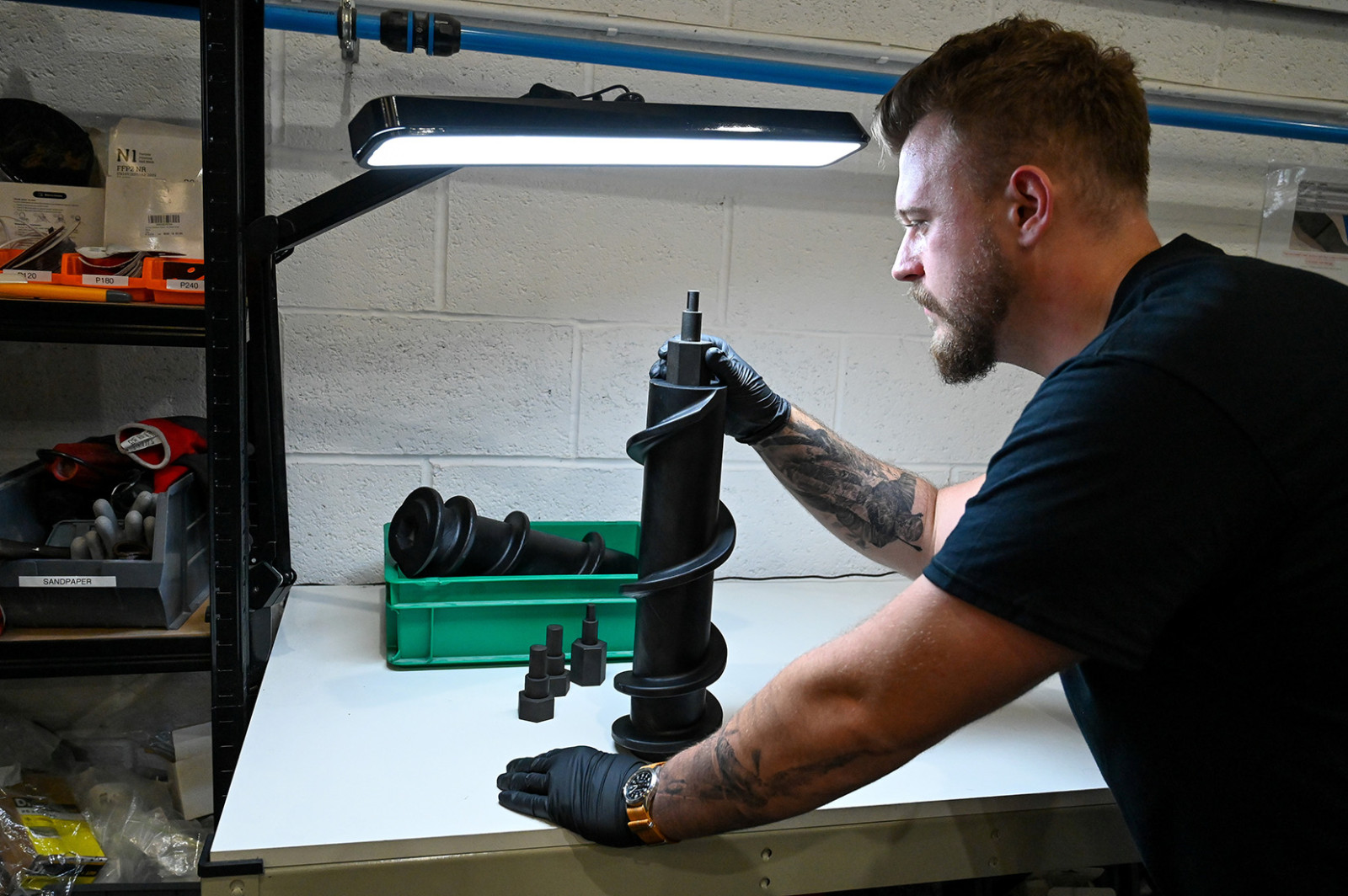
In the high-stakes world of advanced manufacturing, the trajectory of RYSE 3D stands out as a masterclass in accidental entrepreneurship, technical prowess, and bold ambition. What started with a young student putting together his own equipment is now a multimillion-pound technology development firm challenging the global status quo in serial production 3D printing.
The founder’s journey began not in a boardroom, but in a garage. Starting to "mess about with 3D printers from 12 years old," Mitchell Barnes leveraged an unusually supportive design and technology teacher to learn complex skills like milling, turning, casting, and CAD/CAM programming—all before leaving school. This early, deep immersion in traditional manufacturing principles proved critical.
The real spark, however, came during university. Unable to afford the model required to graduate, Mitchell built his own 3D printer from scratch to produce it. This resourceful act immediately exposed a massive market inefficiency. He seized the opportunity by sensing a gap in the market amongst students learning the craft, offering his services to fellow students at half the price the university was charging for traditional clay models.
"It was sort of accidentally entrepreneurial," he recalls. "All I saw was companies in the industry that were either doing prototyping or ones and twos …I knew that there was potential for small to medium volume production and this could be a game changer.”
Capability: Manufacturing the Competitive Edge
RYSE 3D’s breakthrough came from shifting 3D printing from a prototyping novelty to a genuine production solution. It was one of the first companies to successfully change the industry from "just ones and twos and test parts to proper series automated production." This focus on volume and consistency has led to them completing over two and a half million parts in approved, automated production.
This capability is underpinned by a radical, in-house technology strategy. The Warwickshire-based business designs and builds its own 3D printers called LANDR, leading to massive cost efficiencies and a significant competitive advantage over its more established rivals.
“Our machines retail at about £18,000, which is nearly ten times cheaper than what is currently out there in the marketplace” explains Mitchell. “Furthermore, our printers - built from 99% UK parts - take up less space, are quicker and are more precise. It’s a real win-win for us and for our growing customer base for LANDR 3D printers.”
Having its own printers, coupled with proven series production used in 23 hyper-car projects, aerospace components and the medical sector, has proved a highly competitive international sales tool. This has resulted in rapid export growth, with sales jumping from £50,000 in the first few years to over £2million annually in exports to the US, the EU and the Middle East.
The Attitude Blueprint
Beyond the technology, the company’s success lies in its culture. Having grown the business from one (founder Mitchell) to 25 people, the team is deliberately recruited not for prior 3D printing expertise, but for attitude and the ability to master process discipline.
"A lot of our workforce either comes from logistics, coffee shops, or fast food," he notes. "They are process driven people... that’s manufacturing. Follow the process. Start to finish. Deliver the product on time and on quality."
Furthermore, RYSE 3D battles the historical “jobbing shop" reputation of the 3D printing industry by embedding deep client consultation. The firm prides themselves on asking: “Should we even 3D print this in the first place?” By understanding the full end-to-end life cycle of the part, it ensures its work meets the highest standards of cost, quality and time.
Finally, the company invests heavily in its people, offering full private healthcare for employees and their families, and complete flexibility for family and health needs. This demonstrates a core philosophy: investing in the long-term happiness of the staff is the only way to sustain rapid, reliable growth. Ryse 3D’s model proves that radical technology and human-centric culture are the ideal blend for manufacturing success.